Read or analyse?


There’s been a lot of debate recently, on whether it is more important to read books, or analyse them, in a scholarly way
(Obviously, ‘analyse them’ sounds as a more rigorous, sophisticated and high status answer)
Now that’s what I think:
I think of Gesta Romanorum. A medieval collection of entertaining stories, often bawdy ones, many of which were borrowed from the classical authors. But. The medieval monks who did the compilation did not just leave it as it is, but supplanted their stories with a commentary (a sort of ‘analysis’).
That’s how it looks like:
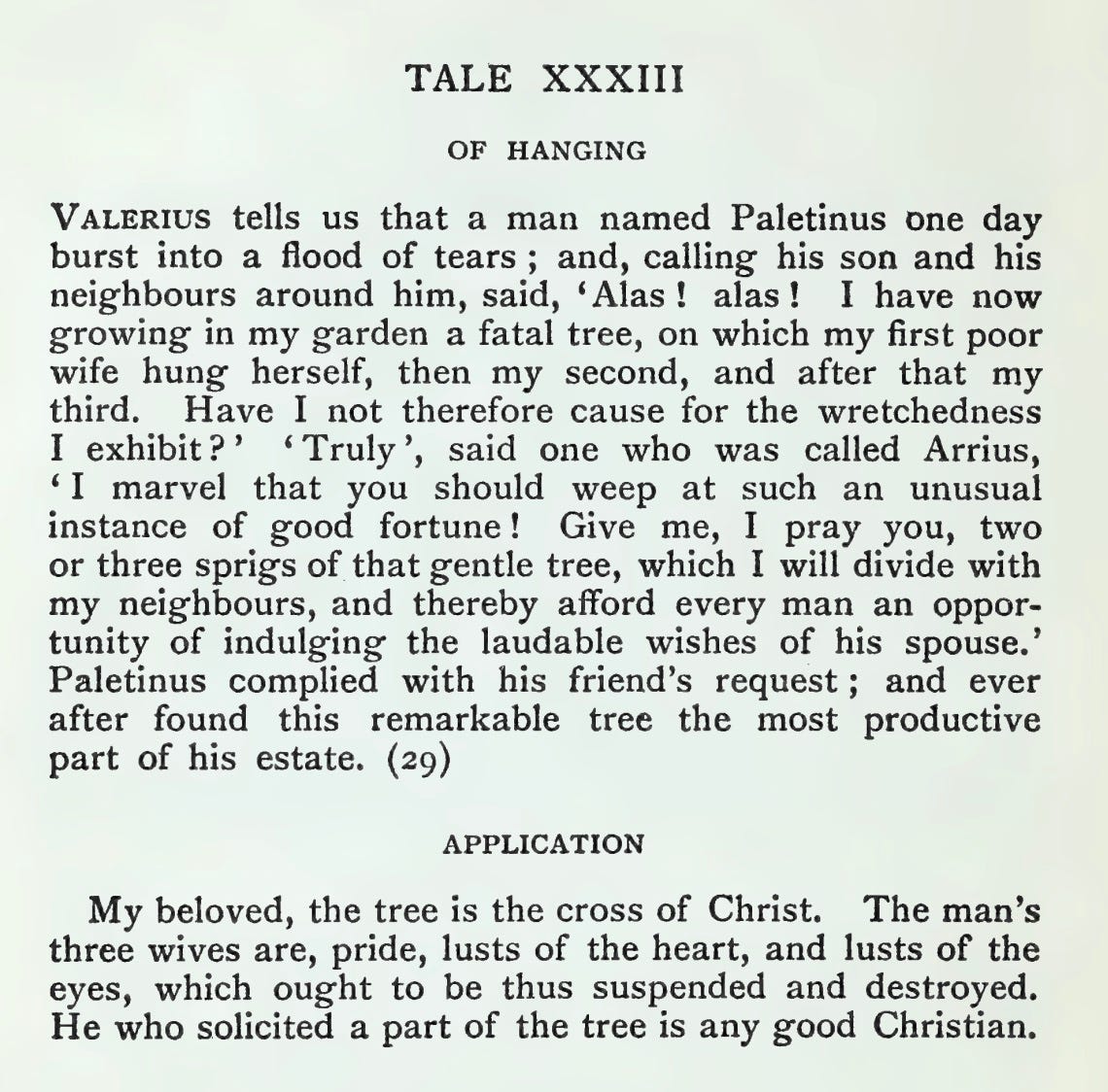
So, basically, every story - and these are usually naughty stories, has this ‘application’ section in the end. Where its contents are ‘analysed’ from the perspective of Christian morality.
Obviously, all or almost all of this analysis is BS, in a sense, that the original author (remember, most stories are classic, coming from the Greco-Roman world) did not mean anything like that. Originally, it was the well-known ‘I hate my wife’ kind of joke. (the earliest version of this anecdote comes from Cicero).

Based on this classification, it is a classical boomer joke, from the Roman world
So what is interesting here, is that the whole ‘analysis’ below the story, was just the made up stuff that the author never meant in the first place. And, I would argue, that this is a typical experience for the literary/critical analyses, rather than some sort of abnormality. Because the people doing analysis are not some celestial beings of pure reason, but rather the living humans, living within the intellectual, ideological and institutional context of the era.
And so the scholar ‘analysing’ the stuff does not just analyse it out of random based on some supposed considerations of pure reason. They are analysing based on the established narratives, accepted by the institutions they are operating in, and from the perspective of these institutions. So, a medieval monk, ‘analysing’ an angry boomer joke of the ancient world, will analyse it from the perspective of Christology, because nothing else would be accepted by his institution (= the monastery).
So, it's not just that the ‘analysers’ of texts can make up stuff, inventing the interpretations that were never meant, nor thought of by the author. It is also that they are not free in which interpretations to choose. If they exist within an institution, that means they are bound by it, and by its official narrative. So, analysis very often works as a sort of Rorschach test, except what it reveals is the official ideology (and epistemology) of governing institutions, rather than the sub-consciousness of a viewer.
Plutarch seemed to do this but with history
The “what the author meant” cottage industry seems to be as old as authorship itself.